Showing posts with label Spring. Show all posts

Friday, May 7, 2010

Spring is Here. Are Your Sprinklers Ready?


It’s spring and is time to fire up your irrigation system, also known as the sprinkler system. Aah, the irrigation clock, I can never get it to do what I want it to do. Or that leaky apparatus (backflow preventer) that sticks out of the side of your house like an oozing sore. And, don’t forget the sprinklers that did not perform correctly last season, leaving a muddy mess or dry spots. These are just a few of the common problems that need to be addressed at the start of the summer season.

Irrigation start up is by far the most important and easiest time to review your irrigation system. It’s the time to adjust sprinkler heads, flush irrigation lateral lines and check the drip system.

These tasks may seem easy in concept but, if there is a problem, then you need someone who has the knowledge to troubleshoot and repair.

Here are some common problems that we all can experience when trouble shooting our irrigation system.

The Irrigation or sprinkler clock has a mind of its own.

Most often the time of day or day has not been set properly or there are programs that have been activated by accident.

The back flow preventer has a drip coming out the bottom.

A backflow preventer prevents outside water from backing up into drinking water- causing contamination. Your back flow is always working and periodically needs to be rebuilt. This should be repaired by a professional. You may also wish to hide the ugly piece of metal jutting out from the side of your home. This is easily done with a shrub or ornamental grasses.

Not all of my sprinkler heads on the same zone have the same amount of pressure.

This could be due to a clogged filter or more importantly - a clogged nozzle.

Another possible explanation is that you have an underground leak. The only solution to this is to work backwards from the sprinkler head and check the ground. If you’re not sure what the direction of flow is, then call in a professional to save yourself a lot of time.

I have a geyser in the middle of my garden where a sprinkler head use to be.

The irrigation system needs to be flushed and the sprinkler head replaced, sometimes not an easy task.

Maybe you noticed last season that you had dry spots in some locations and wet spots in others.

This really sounds like you need an irrigation audit and review. An audit measures the amount of water that each sprinkler head puts out and also allows us to look at the spacing.

Drip systems are the hardest to inspect and review. Sometimes there are hundreds of trees and shrubs on them, and if they are not checked properly and completely then you stand to lose very important and expensive plant material.

One of the most common problems with a drip system are the emitter(s) getting clogged, allowing little or no water through. The drip emitter is a tiny valve that controls water flow at the root area or base of plant. The drip system can be at the surface or underground (subsurface). These all need to be checked. The obvious drip system problem is a broken or missing emitter, which usually shoots water straight up in the air. Another common problem is too much or not enough water to the plants. This is controlled by the size of the emitter, the amount of run time on that station and or the type and size of plant you are watering. These factors together make a drip system quite complex, I recommend hiring a professional to review and inspect your drip system.

These are just a few important problems, solutions and some explanations you might encounter while starting up your irrigation system in the spring.

Enhance Your Garden


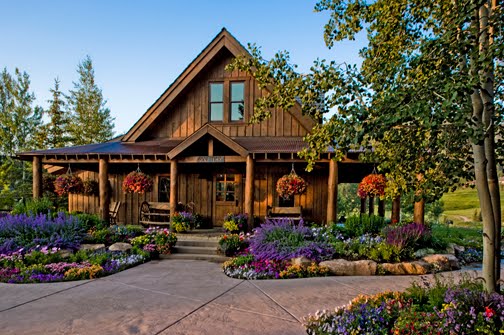
As the snow begins to melt, and the trees and shrubs start to show their spring green it is time to think about summer. Mountain alpine summers are short, so to make the most of our gardens, it is important to start early. For those with existing gardens, you can enhance them by freshening them up. There are a few things we can do to renew our existing gardens, by using annuals and perennials, or to completely renovate and start over with a brand new and improved garden.

Adding annuals to enhance a garden is quick and easy. Examine sun exposure, water requirements, and space to determine the best annuals for your space. Annuals have almost instant color and maintain their color for the entire growing season. This will give you a lot of bang for your buck. But the downside of annuals, is that they die at the first frost, and will need to be replaced yearly.

Many gardens have existing perennials that just need sprucing up. Larger perennials tend to develop a “flopping” look, due to their size. With these, it is best to divide the plant, and then transplant it, to make larger groups with smaller plants. This will encourage the older plants to stand up and bloom sooner and longer. This is especially necessary if you have older perennials that have stopped blooming altogether. It is best to do this during the spring. Re-grouping existing plants into larger groups, helps to give the plants you have more “pop.”

After you have divided, transplanted, and re-grouped your existing perennials, you can then evaluate what types and what quantities of new perennials you will need to add to fill your spaces. After taking into account light exposure, water and space requirements, you will be able to choose the best plant options. The benefit of perennials is they continue to come back year after year, to help avoid large expenses each spring.

For the gardens that are too far gone to revive, a total renovation is the best option. These gardens generally will have more weeds than plants, existing plants that are not performing, and often have poor soil quality. A complete renovation will remove all the weeds, but most importantly, will amend the soil by adding much needed nutrients. Planting new plants in poor, weedy soil will increase the chance of the plant’s failure. After amending the soil and adding plenty of nutrients, we can add new perennials, annuals, shrubs and trees to make the perfect bed.

For any of the enhancement ideas above, proper irrigation is a must. While many plants have lower water requirements, all plants do require consistent water. During the first two weeks of a new plant’s life, this is especially important.

Land Designs by Ellison and A Cut Above Landcare offer a free consultation on the quality of your irrigation system, as well as what plants will work best in your space. We can help to get you started to ensure your best chances for success.